Car rental fleet occupancy measures the amount of vehicle use during a specific period, but it does not alone explain profitability. The percentage can rise with significant discounts or decrease due to planned maintenance. Before comparing one month to another, agree on the counting method, the cars included in the calculation, and how you handle stops and partial periods.
Basic fleet occupancy equation
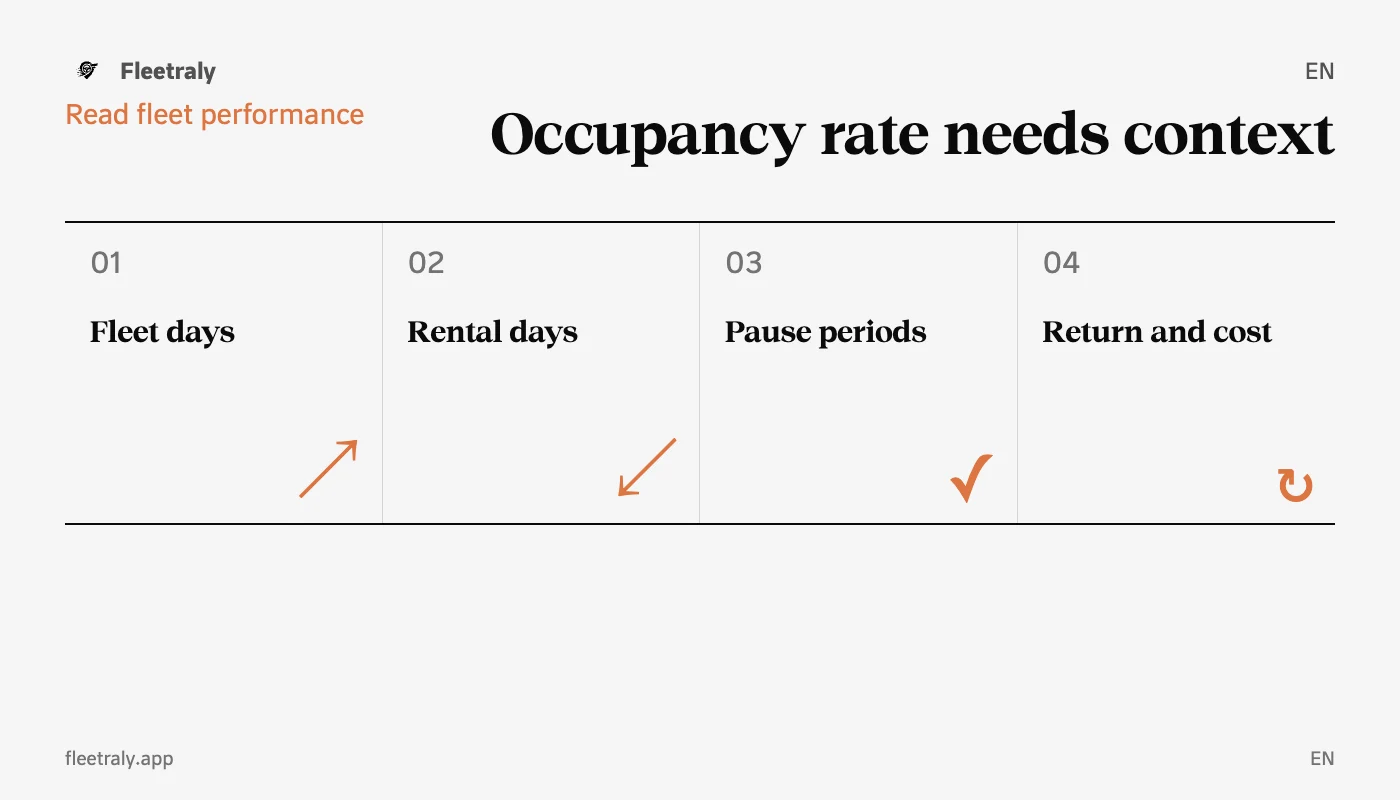
Fleet occupancy = actual rental days ÷ total fleet days during the period x 100. Calculate the total days for each vehicle based on its actual presence within the measurement range; A car added in the middle of the period does not enter the full number of days in the month.
A fleet of 10 cars over a period of 30 days saves 300 car days, if all the cars remain in the fleet throughout the period. When recording 180 actual rental days, the occupancy percentage is 180 ÷ 300 x 100 = 60%. These values show the calculation method and do not represent an appropriate target for each company or a result achieved by a particular company.
Total occupancy and utilization of available days
| Indicator | The denominator used | What helps you understand it? |
|---|---|---|
| Total fleet occupancy | All motor days included in the period. | The extent of use of the fleet size that the company is responsible for operating. |
| Take advantage of available days | Days used are available for hire after excluding scheduled downtime. | The extent of utilization of operational capacity that remains available. |
If out of 300 car days, there are 30 stopping days that are excluded according to your definition, then the available days become 270. With 180 rental days, the utilization rate of what is available is about 66.7%, while the total occupancy remains 60%. The difference is due to the denominator used, not a new improvement in demand.
Specify the counting rule before extracting the report
- The period, time zone, branch and vehicles covered by the measurement.
- Is the calculation in full days or hours? How are delivery and return periods treated?
- Carry out rentals are calculated separately from future or canceled reservations.
- Definition of excluded downtime: Maintenance, vehicle preparation or other documented reason, with exclusions prohibited.
For accurate comparison, use the same unit in the numerator and denominator. Do not add the commercial days billed in the numerator with the availability hours converted to days in the denominator without unifying the approach; Results may exceed actual usage. Do not count one period twice due to overlapping records.
Why is a high percentage not enough to make a decision?
A car rented for most of the month may have a poor return if its cost or deductibles are high. Read occupancy with rental income, average return, maintenance intervals and recorded cost. Separate the amount due from the amount collected. Collection alone does not equal the vehicle's performance over the period.
When comparing categories, take into account the age of the cars, seasons of demand, and the nature of contracts and branches. Don't let the average fleet hide a discontinued category or branch that is short of needed vehicles. Start with the question you want to answer, then choose the appropriate breakdown.
How does Fleetraly help you review context?
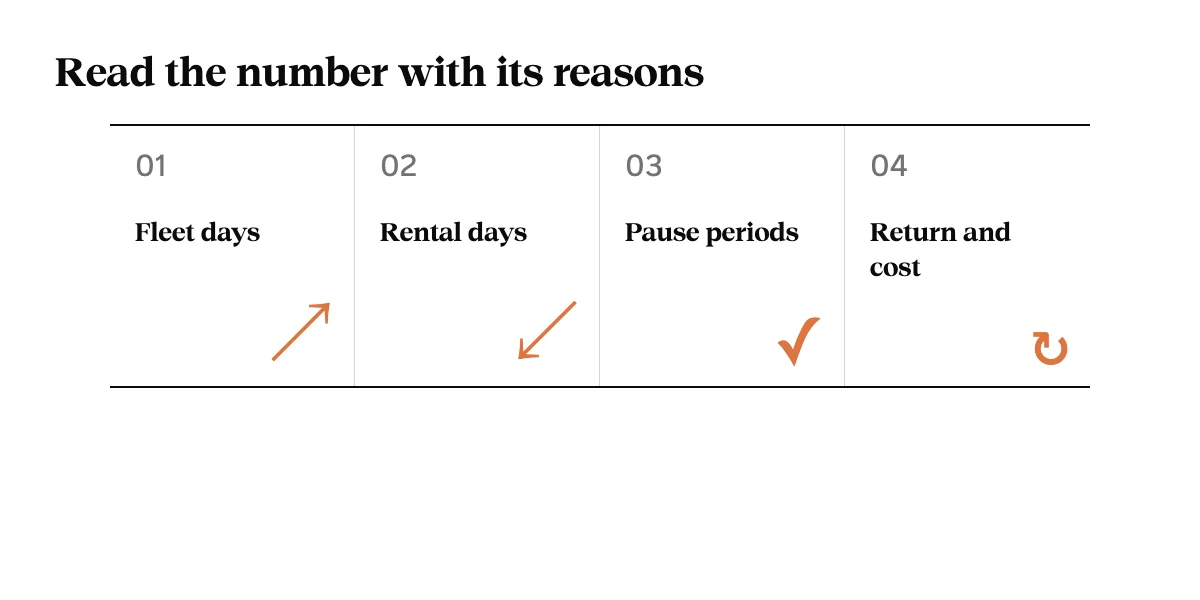
Collect vehicle data, reservations, maintenance and payments into a cohesive workflow that helps you reference records that explain performance. In Fleetraly you can start your review from these records, then match the definition of any indicator in the report you rely on to your equation; Do not assume that every report uses the same denominator or rounding rules.
- Choose a short period and a specific group of vehicles whose records you can review.
- Match actual rental and downtime periods to the condition of each car.
- Calculate the total occupancy and available utilization separately.
- Review revenue, cost and collection status before deciding to change price or increase fleet.
Frequently asked questions about the occupancy rate of rental cars
What is the ideal occupancy rate?
There is no single goal that works for all companies. Determine it according to the market, season, costs, and type of contracts, then review the return, readiness, and quality of service next to it.
Do I delete maintenance days from the account?
Keep it in the denominator of total occupancy if the vehicle is in the measurement fleet, and exclude it only when calculating the available days indicator according to a clear definition. Label the two indicators clearly so that the comparison is understandable.
Start from data that can be interpreted
Prepare your vehicle data, reservations, and maintenance records in Fleetraly, then review a specific period instead of just a general average. When you can explain why a car is empty or stalled, the number becomes an input into a practical decision.
Links to help you get started
Explore fleet data organization in Fleetraly
How to organize a rental fleet maintenance plan?
Register your company and start preparing your fleet records